|
|
Welcome to our blog 'The Buzz'. Here we will keep you updated on what is happening in the world of bees and honey and anything else that we think you would be interested in. If there is a topic you would like to hear about drop us an email and I'll see what we can do.
Written by Stephanie on May 7th, 2013.
0 comments
It is great now our boys are getting a bit older (eight and ten) and getting more interested in our honey business. Last week, being school holidays, they came out with us to pack the latest Hakarimata honey. I was thinking it was going to be hard with them asking how much longer we would be and saying they were bored. But I was pleasantly surprised! They worked well for five hours (with morning and and lunch break as well of course) without one complaint!
Matthew's job was to put the lids on the small jars and Daniel's was to empty the pallet of empty jars into boxes then make sure we all had enough jars up on the tables to fill them. They really loved it!
Matthew loves to help with labeling the jars and is very good at placing the award stickers. Daniel has his own beehive and hopes to produce some comb honey this year. Matthew is looking forward to getting his own hive this year too!
Written by Stephanie on April 11th, 2013.
0 comments
What a great honey season it has been! We have a bumper crop of Marokopa Manuka this year which has been tested with an activity level of 5+. S amples of Sweetree honey tested have a HMF level of <4mg/kg, indicating very low levels of heating and very fresh honey!
Also in this newsletter read about how Simon Gault loves our honey, about our photo competition and get a great cold and flu remedy recipe!
Read more here
Written by Stephanie on April 9th, 2013.
0 comments

What a great harvest of honey we’ve had this season! We have a bumper crop of Marokopa Manuka and it has turned out to have an activity of 5+. Find out more about this.
We have packed most of the honeys ready for sale, you can see these in our online store. We have just extracted out Marokopa Summer and Hakarimata honeys and these will be packed over the next month.
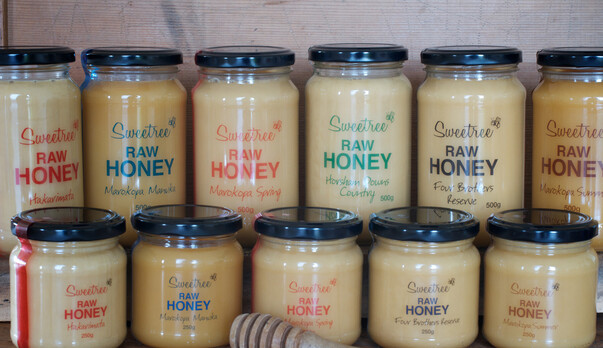
As you may know, we try to produce honey which is a refection of the great diversity we have here in the Waikato. Much like a great wine reflects the terroir of where the grapes have grown, Sweetree Honey’s different varieties reflect the area and season the bees worked their magic. And just like a wine the flavour changes with each vintage. You will notice the honeys are quite different in colour, texture and flavour from last year. In spring, Heketara flowered strongly, but there was no Rewarewa, and there was a huge amount of clover. Our Marokopa Manuka and Spring are lighter in colour this year and the Four Brothers Reserve has come out much darker! Remember, our west coast manuka, has always been lighter than other manuka honeys, and manuka honey can be a wide range from light to dark amber.
We will shortly update the photos of each honey on the website, so you can get a good look at them. Updated tasting notes will be next, so watch this space!
Written by Stephanie on March 20th, 2013.
0 comments
Simon Gault, Chef, TV personality and author was giving a cooking demonstration at Westfield Chartwell about a year ago. A friend suggested I drop some of our honey to him to try. So packed up a couple of honeys with a note explaining about us and our honeys and dropped it to Simon's assistant after the demonstration. I felt a bit nervous.
Would you believe that a photo of our 'Four Brothers Reserve' honey is now photographed in Simon's new cookbook 'Homemade'!!!! We were blown away!
Simon had 'A Night with Simon Gault' in Hamilton recently so I got him to sign the page in my book. He wrote - 'Love Your Honey!'.
So if you have a copy of the book have a look at page 228 and if you don't have a copy get one. It is great cookbook, they are all recipes that he and he family (including his parents) use at home. So they are not hard and use ingredients that you probably already have. You can purchase the book from his website - Sous Chef
I got a copy for Mum for her birthday and she is really enjoying it.
Written by Martin on March 6th, 2013.
2 comments
Doesn’t time fly when you are having fun! The season is almost over and many beekeepers will be very happy with their honey crop this year. The hot dry weather has been great for the bees with a lot of honey collected and good conditions for drawing out wax on frames. Did you notice the white blooms of the native Heketara tree flowering in spring? The last time I saw flowering similar to that was about 5 years ago – when we had the last drought! This has been noticed before by beekeepers , when the Heketara flowers in spring, watch out you may be in for a drought, or at least a good long dry summer.
Marokopa Station
 After a slow start, the bees really took off. We harvested the Spring crop in late December, mostly Kamahi, just in time before the Manuka started flowering. It was even later than normal this time, mid December is generally when it flowers. Masses of flowering this year which finished in late January. There was such a strong flow of honey this year, that I don’t think the bees even noticed us taking off the honey, they were too busy getting the next load! We undertook our third harvest in mid March, the summer crop, (thistle, clover, rata). The beehives now have entrance reducers on to keep the wasps out and all have varroa strips, because mite levels are now high.
Four Brothers Reserve
This farm has changed hands and is now owned by a native forest restoration society. The pasture has been left to do its own thing and there were flowers and long grass everywhere. Despite this the bees didn’t do quite as well as we hoped, but we did get a sufficient crop to allow us to do a pack.
I was out with our eldest boy at this site on a hot windy day in January with a very high pollen count. He went for a wander through the grass while I looked at the bees. Next thing he was coming back with tears streaming down his checks and welts coming up on his skin. Then he started coughing and gasping for breath – yes he had an anaphylactic reaction to the grass pollen. Luckily it wasn’t too bad and we got him some treatment, but now he carries an Anapen!
Hakarimata Range
We hit seven stories high on some of the hives at this site! Packed with bees and honey and a very good crop taken off. We are down to the last two jars of last years Hakarimata honey, so the sooner we get this extracted the better!
Opoutere
We did manage to get a crop of manuka honey from this apiary site – fantastic honey and while the crop was small we have come up with a great way to eat it! Look out for this honey at the Farmer’s Market in Hamilton and give it a try.
Kawhia
Our new trial site, the hot dry weather has been very tough on this farm and flowering finished early. The nectar flow has been a stop/start affair and the bees have generally been a bit below par. However, that’s what happens when you try a new site and it takes a while to understand the nuances of the area. The site has masses of lupins and the bees draw huge amounts of brightly coloured pollen from the flowers. The frames are full of pollen. We have harvested a small quantity of honey and what we have tasted has been very different. A salty, gritty taste – sort of like the sea! And it tastes great, so we will make it available and see what everyone thinks.
Horsham Downs
Our home apiary site and where we collect our bee pollen. This has been a tough year for collecting bee pollen in the Waikato – the wet spring meant that pollen collection was below average and then the bees became very focused on collecting honey in summer! Here’s hoping that Spring 2013 treats us kindly!
Written by Stephanie on March 1st, 2013.
0 comments
When we were deciding how to package our honey it had to be glass. It is so much more healthier, attractive and environmental friendly. I came across this on Glass for Life facebook page which sums it up quite well - "People trust glass more than any other packaging material to protect the flavor and freshness of their food and drink. And for good reason. Glass is safe and healthy, pure and virtually inert. It’s made of natural ingredients—sand, limestone and soda ash. Glass is 100% recyclable and highly sustainable— unlike most other packaging materials, it can be recycled over and over. And glass says quality without even trying. Glass is life, for all the right reasons."
Lately I've been reading on Facebook how our customers reuse their Sweetree honey jars. They are used for jams, chutneys, sauces and for storing items. What do you use empty Sweetree jars for?
We would love to see what people do with them so we have decided to start a photo competition. Post a photo on our Facebook page of a Sweetree Honey jar being used creatively and you could be in to win! If you don't have Facebook just email to us at info@sweetreehoney.co.nz and we'll pop it up for you.
Please note the photos are not being judged on photographic ability but rather the original use of one of our empty honey jars!
Please vote for your favourite photos by liking them on Facebook and ask your friends to vote too!
The best photo at the end of May wins a Sweetree Honey gift box with the latest season's honeys plus the latest Good Magazine and three back issues of the NZ Farmer Lifestyle Magazine - worth a total of $60!
Here's some ideas from our photographer. Don't worry Claudia isn't allowed to enter!
Written by Stephanie on February 19th, 2013.
0 comments
As you may have read in my last blog worker bees only sting if they feel threatened. But there are times when you just can't avoid being stung, if this happens what should you do?
Please note: Bee stings can give different reactions, from temporary pain and discomfort to a severe allergic reaction. This blog does not cover severe allergic reactions. If you have a severe allergic reaction please seek urgent medical attention. If a reaction persists for over a week or covers an area greater than 7–10 cm please see a doctor.
Taking the Sting Out
When a bee stings you, the barbed stinger remains embedded in the skin, attached to the stinger is the venom sac, which can carry on pumping venom into the body for up to 10 minutes. For this reason doctors recommend removing the stinger as soon as possible.
It used to be said that pinching or squeezing the stinger could empty the venom sac into the sting, making things worse. Studies have since shown the amount of venom released does not change whether the sting is pinched or scraped off, but a delay of a few seconds leads to more venom being injected. Therefore, stingers can be removed by either scraping or brushing them away, or by pulling them out of the skin.
Remedies
The sting may be painful for a few hours and swelling and itching may last for a week. You should avoid scratching the area as this may increase the itching and swelling. Once the stinger is removed try to wash the area with soap and warm water and place a cold compress on top to reduce the pain and swelling. Or you could try any of these remedies.
-
If you are in a remote area you could spread mud on the area and let it dry, but wash with soap and warm water when you can.
-
Spread baking soda paste on the area and allow it to dry. Using this or the mud draws the poison out of the area.
-
Pain medications and antihistamines can also help relieve pain, swelling, and itching in the area.
-
Apply toothpaste.
-
Mix a paste of vinegar and baking soda and place on the sting.
-
Apply honey.
-
Apply calamine lotion or hydrocortisone cream.
Some of our customers recommend:
-
Rub an ice cube over the area till it is melted or the pain has gone away which might take two cubes! This method is so effective and seems to stop swelling and even the itchiness you get a few days later!
-
Chop an onion in half and pop it on the sting, it seems to draw out the nasty stuff.
-
Take Homeopathic Apis.
-
Apply vinegar straight away, followed by a kombucha scoby wrapped on to the sting.
-
packet of lollies for a child...works a treat, for total distraction!
Some information for this blog was research from www.en.wikipedia.org and www.wisegeek.com
Written by Stephanie on February 12th, 2013.
0 comments

Have you ever been stung by a bee? I think I have only been stung once when I was about 10 years old. I still remember it clearly as if it was yesterday. I was walking in the grass in my lovely red roman sandals at school and as I lifted by foot to walk a bee flew under my toes and as I stepped it stung me. It gave me a huge fright and man did it sting! I didn't get a reaction and I don't even remember how I got the sting out but from then on I was scared of bees and getting stung again.
Of course after meeting Martin I have grown a new appreciation for bees and I am now comforted by the fact that a honey bee will rarely sting when it is away from its hive foraging for nectar or pollen. The only reason a bee would sting someone is if they stepped on it or handed it roughly. Bees will however attack intruders who are disturbing their hive. Hence Martin has had hundreds of stings! When a bee stings it also releases an ‘alarm pheromone’ to signal to other bees in the hive to attack. This is one of the reasons why beekeepers use smokers when they are working hives, it covers up the alarm pheromones. Because the worker bees release the alarm pheromone when threatened Martin is very careful not to crush or harm the bees when harvesting honey.
So my advice to you would be don’t wave your arms around when a bee comes near you, just sit there quietly and still and when it realizes you are not a flower it will move on. And if you are going to look into a beehive always wear a suit!
Here are some interesting facts about bees and their stings:
-
Bees are the only insect with a strongly barbed sting
-
As the sting lodges into the victim’s skin it tears loose from the bee’s abdomen and the bee die within minutes
-
The female bees (the queen and the worker bees) are the only ones that sting
-
The queen’s stinger is smooth so can therefore sting over and over (but don’t worry she never leaves the hive unless she is swarming to find a new home)
-
A swarm of bees is not aggressive, they are just looking for a new home and have no honey or young to defend
-
The large drone bees do not have stingers
-
A bee sting consists of three parts – a stylus and two barbed sides
The next blog will give you some tips of what to do if you are stung.
Some information for this blog was research from www.en.wikipedia.org and www.wisegeek.com
Written by Stephanie on February 5th, 2013.
1 comments
We would like to increase our fan base on Facebook and we need your help! We have a few prizes to give away – so share our Facebook page with your friends, tag people you know will love Sweetree Honey, like our posts or comment on them and we will start randomly rewarding you with goodies from the list below!
So far the prizes we have include:
-
Sweetree honey, of course
-
NZ Lifestyle Farmer Magazines
-
Good Magazine
-
Beeswax tea light candles
-
Skinfood products
-
Coconut oil in an easy bar
-
Wax melts (makes your house smell wonderful!)
We have more prizes coming so watch this space!!!
So interact with our Facebook page and you may receive something from this list!
Written by Stephanie on December 24th, 2012.
0 comments
It's Christmas Eve! Here at the Lynch household the boys are very excited. Santa is coming tonight! The feed will be sprinkled out on the back lawn for the reindeer and a homemade shortbread and a glass of milk (or maybe beer) will be left out by the fireplace for Santa. So exciting. I love Christmas!
We wish you all a wonderful Christmas spending time with family and special friends and have a safe and fun new year!
Here a very famous poem for you to read tonight from Clement Moore and/or Henry Livingston Jr.
Twas the Night Before Christmas:
Twas the night before Christmas, when all through the house
Not a creature was stirring, not even a mouse.
The stockings were hung by the chimney with care,
In hopes that St Nicholas soon would be there.
The children were nestled all snug in their beds,
While visions of sugar-plums danced in their heads.
And mamma in her ‘kerchief, and I in my cap,
Had just settled our brains for a long winter’s nap.
When out on the lawn there arose such a clatter,
I sprang from the bed to see what was the matter.
Away to the window I flew like a flash,
Tore open the shutters and threw up the sash.
The moon on the breast of the new-fallen snow
Gave the lustre of mid-day to objects below.
When, what to my wondering eyes should appear,
But a miniature sleigh, and eight tinny reindeer.
With a little old driver, so lively and quick,
I knew in a moment it must be St Nick.
More rapid than eagles his coursers they came,
And he whistled, and shouted, and called them by name!
"Now Dasher! now, Dancer! now, Prancer and Vixen!
On, Comet! On, Cupid! on, on Donner and Blitzen!
To the top of the porch! to the top of the wall!
Now dash away! Dash away! Dash away all!"
As dry leaves that before the wild hurricane fly,
When they meet with an obstacle, mount to the sky.
So up to the house-top the coursers they flew,
With the sleigh full of Toys, and St Nicholas too.
And then, in a twinkling, I heard on the roof
The prancing and pawing of each little hoof.
As I drew in my head, and was turning around,
Down the chimney St Nicholas came with a bound.
He was dressed all in fur, from his head to his foot,
And his clothes were all tarnished with ashes and soot.
A bundle of Toys he had flung on his back,
And he looked like a peddler, just opening his pack.
His eyes-how they twinkled! his dimples how merry!
His cheeks were like roses, his nose like a cherry!
His droll little mouth was drawn up like a bow,
And the beard of his chin was as white as the snow.
The stump of a pipe he held tight in his teeth,
And the smoke it encircled his head like a wreath.
He had a broad face and a little round belly,
That shook when he laughed, like a bowlful of jelly!
He was chubby and plump, a right jolly old elf,
And I laughed when I saw him, in spite of myself!
A wink of his eye and a twist of his head,
Soon gave me to know I had nothing to dread.
He spoke not a word, but went straight to his work,
And filled all the stockings, then turned with a jerk.
And laying his finger aside of his nose,
And giving a nod, up the chimney he rose!
He sprang to his sleigh, to his team gave a whistle,
And away they all flew like the down of a thistle.
But I heard him exclaim, ‘ere he drove out of sight,
"Happy Christmas to all, and to all a good-night!"
Written by Stephanie on December 11th, 2012.
0 comments
As 2012 is nearing an end and Christmas is around the corner we would like to thank you very much for supporting us this year. We really appreciate it. Thanks for your encouragement and great feedback, we love receiving them.
In this newsletter read a round up of what what exciting things Sweetree has been involved in this year, get an update on what Martin has been up to at the hives, read about Clyde Stratford's (beekeeper and founder of Comvita) elixir of life at a grand old age of 102! Also see the delicious Panforte recipe you can whip up for Christmas!
Read more here
Written by Martin on December 5th, 2012.
0 comments
We've officially hit summer and the bees are bringing in nectar into the hives. The recent period of fine weather has allowed the bees to draw out the frames and build up to good levels. Spring was very much a stop start affair which made for a slow buildup of colony strength and extended periods to get virgin queens mated. Bee pollen has also been slow coming in which has made it difficult to meet the demand from our customers - sorry! However the forecast for summer is hot and dry and this should mean a good honey harvest. Honey supers are now on hives.
Around the sites:
Marokopa - a fantastic showing of Heketara this year, you can smell the fragrance of the nectar in the hives. However poor weather has limited any surplus, so Marokopa Spring may well be in short supply! Manuka expected to start in late December.
Four Brothers Reserve - hives doing very well and large quantities of flowering plants, Kanuka is just flowering now.
Horsham Downs Country - bee pollen is starting to pick up and hives are becoming strong. Good quantities of pasture flowers coming through now.
Hakarimata - very strong and good bee numbers. Just been through a dearth of nectar but expecting flowering to take off now. Looking forward to some more award winning honey.
Kawhia - a new site, huge quantities of lupin pollen coming into the hives, and good buildup. Kanuka flowering and Pohutakawa expected to flower shortly. So close to the sea, you can taste the salt!
Opoutere - a new site, masses of Manuka flowering, the bees will be working hard to get a surplus of honey however.
Written by Stephanie on November 13th, 2012.
0 comments
Annabelle White, Chef, Author and TV personality was giving a cooking demonstration in Hamilton in September. As a thank you Kitchen 'n' Things gave her a jar of our Hakarimata honey.
I contacted her a couple of months later to see what she thought of our honey and this is what she said:
"I opened the jar and tried the honey Hakarimata is super - intense and full flavoured and quite delicious"
She has since used our honeys in charity gift boxes.
Written by Brownyn Lowe on November 5th, 2012.
0 comments
Plant some herbs this summer to attract bees to your garden. With some pre planning and planting you are guaranteed to have bees buzzing in your garden patch all summer long. Even when our herb garden was in it's first year of growth we had bees galore. A bee keeper once told me that bees love blue flowers and I have found this to be true.
Some good plants to start with include:
Borage Borago officinalis, is a blue flowering annual herb that can be planted from seed or you can often buy plants, from your local herb supplier. Borage has abundant star shaped blue flowers that bloom throughout the summer and attracts many bees. Once you have a borage plant in your garden it will often seed itself and you will have new plants each year as soon as the soil warms up.
Thyme Thymus vulgaris, there are many different varieties of Thyme, all equally loved by the bees. Three good Thyme plants to have in your garden would be pizza thyme, (with its vigorous growth it can stand regular picking) Lemon thyme, (with its silver foliage makes a nice contrast and flavour to your dishes, It also has a pleasant lemon scent). And the common garden thyme which is the most widely-known and used.
Sage salvia officinalis, with its blue flowers, is a bee favourite. Easy to grow, there are two common sage plants that you may know. The green sage is the most commonly used for culinary purposes. Red sage is mainly used medicinally although it can also be used for culinary purposes, it also makes a lovely carpet-type cover in your garden.
Rosemary rosmarinus officinalis, have you heard the old wives’ tale that if the rosemary plant is thriving in the front garden the woman of the house is the boss? Maybe it just meant that the garden was well cared for, which in turn would lead to a healthy garden for the bees. Rosemary is another blue flowering plant, easy to grow, just don’t over-water it. Make sure to pick often to prevent it getting too spindly. Pop some flowers into your salad for a taste sensation just leave some for the bees!
Catmint nepeta faassenii, is a pretty blue flowering plant that can be used as a ground cover and a companion plant. Ideal for planting around roses (which the bees also love).
Although we have concentrated on blue flowering plants, bees do like other flowers, last year in our garden they loved the echinacea flowers, we often saw them on the calendula and bergamot flowers. The pineapple sage with it’s bright red flowers was a favourite.
All these plants are common and readily available at your local garden centre or herb supplier. Plant for the bees and have some fun in your garden this summer! As an added bonus the monarch butterflies seem to love these flowers as well.
This article was written by Bronwyn Lowe, Medical Herbalist, from the ' Herbal Dispensary' in Raglan. At the Herbal Dispensary they are passionate about assisting you and your family achieve optimum health and vitality. Their wonderful shop in Wallis Street is filled with wonderful natural products - you'll find all you need to support your health naturally. Their health clinic can provide you with a comprehensive, individualised natural health service including herbal medicine, nutritional and dietary, analysis testing, mineral assessment, etc.
Check out their website here to find out more, purchase online, read articles and much more.
Written by Stephanie on October 29th, 2012.
0 comments
Can you believe Christmas is only eight weeks away! Where has the year gone! It is a busy time of year here at Sweetree, as you will see in Martin's beehive update below. Finally the sun has been shining here for a couple of days, so the bees are very happy. Hopefully they will collect heaps of pollen so we can have it available ongoing soon.
A couple of weeks ago we were asked to be part of a program called 'Catch and Cook' on Choice TV. In 'Catch and Cook' Adventure Aaron travels around New Zealand catching ingredients for wild food dishes cooked by celebrity chefs. In the episode we were involved in Chelsea Winter (Master Chef winner) sent Aaron to catch whitebait and collect honey for a delicious meal she cooked us at the Tuakau Hotel. We loved the experience, it was heaps of fun!
With Christmas around the corner we have a great line up of gift ideas this year. There is something for everyone, including crayons made with beeswax for the kids! We are also offering a great discount for businesses looking for that something special for customers or employees this year.
Read the rest of our newsletter
|